Black Toe or Foot (Possible Gangrene)
A black, dark purple or bruised area on the toe or foot of someone with diabetes can be a sign of tissue death. Causes and first steps.
Short answer
A black or dark purple area on the foot or toe of a person with diabetes can show that not enough blood is reaching that tissue and that the tissue is dying (gangrene). It does not go away on its own. See a healthcare provider the same day; if there is fever, a bad smell or spreading redness, go to an emergency department.
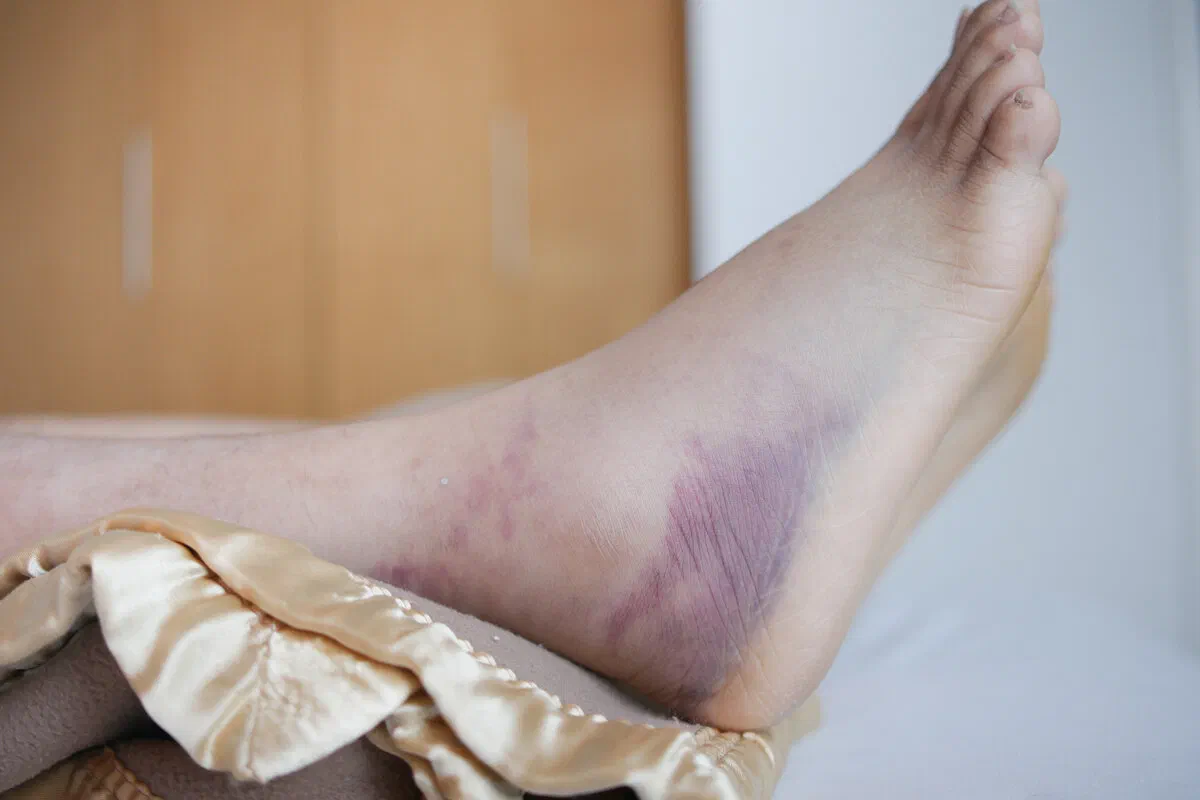
A black, dark purple or bruised-looking area on the foot or toe can show that blood flow to that area is inadequate and that the tissue is being damaged. In people with diabetes this often progresses without pain because of nerve damage; the person only sees it when taking off a sock or when a relative notices it.
What can this colour change mean?
| Appearance | Possible meaning | Urgency |
|---|---|---|
| Dry, hard, black toe tip | Tissue death due to inadequate blood flow (dry gangrene) | Same-day assessment |
| Black area together with swelling, discharge, bad smell | Tissue death accompanied by infection (wet gangrene) | Emergency |
| Cold, pale or purplish foot; sudden pain | Sudden blockage of an artery | Emergency |
| Dark patch under a callus | Bleeding under the callus; there may be a wound underneath | Within a few days |
| Bruise after a knock | May be a simple bruise | Should still be shown to a doctor in a person with diabetes |
It is not safe to tell these apart at home. The earlier the situation is assessed, the more tissue can be preserved.
Possible causes
- Peripheral artery disease: Narrowing or blockage of the arteries of the leg and foot. It is common in diabetes and often causes no symptoms.
- Infection: An infection added to a wound can block small blood vessels and cause tissue to die quickly.
- Pressure and injury: Tight shoes, load on the same spot for a long time, burns (hot water bottle, stove) or frostbite.
- Clot: A clot that breaks off from the heart or the large arteries and blocks an artery of the foot.
What to watch out for at home
- Do not cut, scrape or prick the black area with a needle.
- Do not try to warm it: hot water, hot water bottles and heaters cause burns on a foot that has lost feeling.
- Do not apply creams, ointments or herbal mixtures.
- Cover it lightly with clean, dry gauze; do not wrap it tightly.
- Keep weight off the foot.
- Take a photo; it helps to follow whether the edges of the area are changing.
What is done during the assessment?
- Circulation examination: Pulses are checked by hand and with Doppler; ankle and toe pressures are measured.
- Imaging of the blood vessels: If needed, the site of the blockage is identified with Doppler ultrasound, CT or MR angiography.
- Infection assessment: Redness, discharge, smell and fever are looked for; blood tests and culture are requested.
- Bone assessment: X-ray, and MRI if needed.
- General condition: Blood sugar, kidney function and the state of the heart.
How is treatment planned?
The order of treatment depends on how urgent the situation is.
- If there is infection, it is brought under control first: antibiotics, draining of any abscess and removal of dead tissue are carried out without delay.
- If blood flow is inadequate, vascular surgery or interventional radiology considers increasing the blood reaching the foot with a balloon or stent, or with bypass. The wound from surgery done before blood flow is restored may also fail to heal.
- Dead tissue is removed surgically once its borders have become clear. In dry gangrene without infection, the border is sometimes allowed to become distinct first.
- Wound care, offloading and blood sugar control are the constant parts of treatment.
When amputation has been recommended and the situation is not urgent, getting a second opinion before the decision is a reasonable step.
Assessment in Istanbul
Whether or not there is infection in blackened tissue determines the speed and order of treatment. As a specialist in Infectious Diseases and Clinical Microbiology, Prof. Dr. Aytaç Çetinkaya assesses the infection side of these cases and recommends working together with vascular surgery. If there are no emergency signs, patients in Türkiye and international patients can send a photo of the area and their reports on WhatsApp to ask for a preliminary review. A preliminary review does not replace an examination. If there are emergency signs, do not wait for a reply to your message.
Frequently asked questions
Will the black area go away on its own?
Is every black spot gangrene?
What is the difference between dry and wet gangrene?
Does a blackened toe always have to be removed?
References
This page is for general information only and does not replace an examination, diagnosis or treatment. In an emergency, call your local emergency number or go to the nearest emergency department.